Trump's "Status Quo Theory" as Taiwan's Chronic Poison
The Storm Media Opinion, May 21, 2026
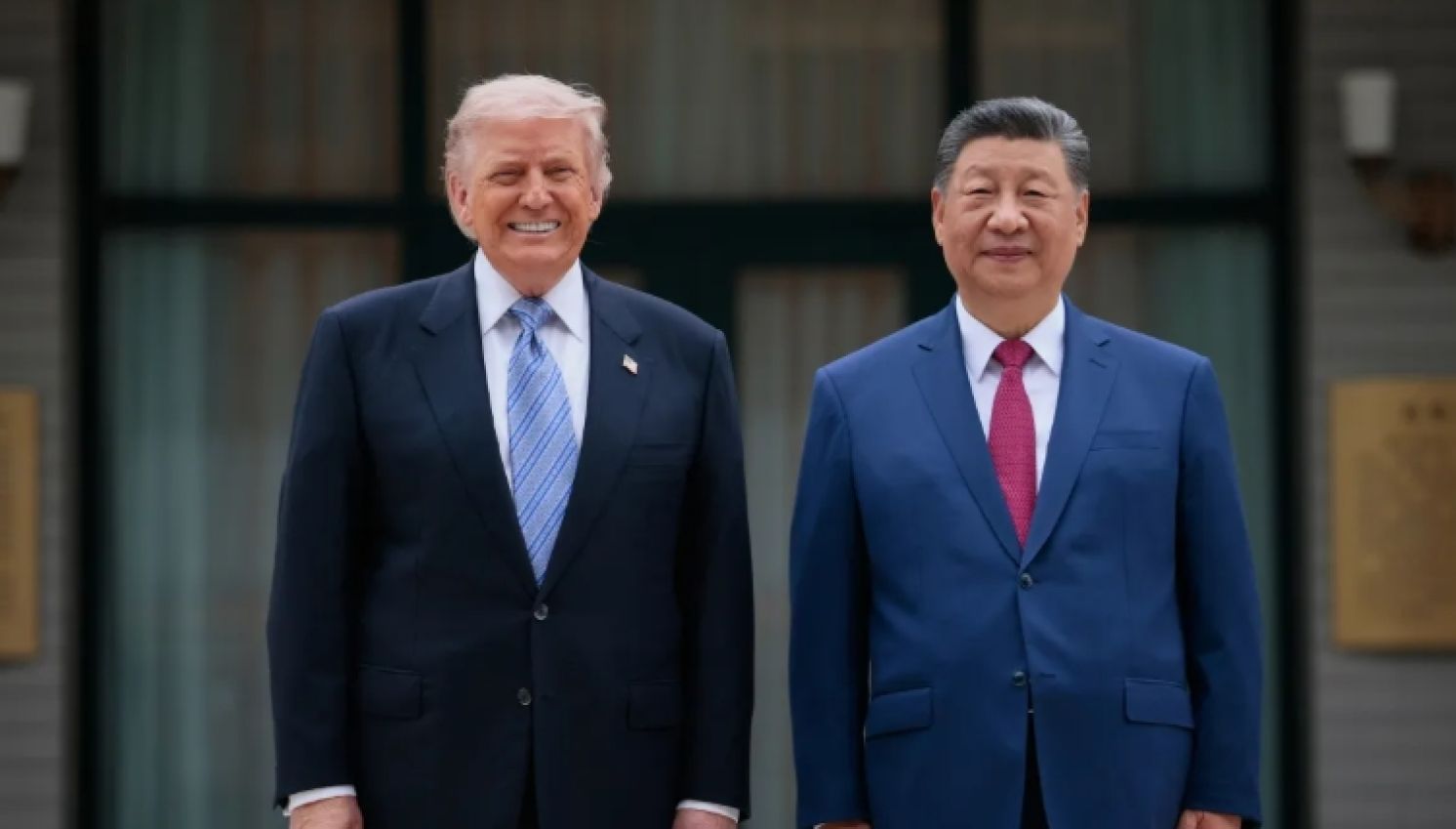
After concluding his summit with Chinese President Xi Jinping in Beijing, President Donald Trump of the United States first spoke with reporters aboard Air Force One and later gave an exclusive interview to Fox News anchor Bret Baier, providing the summit with its true political footnote: The United States has not publicly abandoned Taiwan, yet it is quietly shifting the language surrounding Taiwan’s security.
The first warning sign came from Mr. Trump’s remarks aboard Air Force One. Mr. Trump confirmed that the two leaders “talked a lot” about the Taiwan issue in Beijing and that he had not yet made a decision regarding the $14 billion arms sale package to Taiwan. He said that after speaking with “the people in charge of Taiwan,” he would “make a decision sometime soon.”
Taiwan was placed within the framework of closed-door negotiations, presidential discretion, and great-power bargaining. In the past, although U.S. arms sales to Taiwan were influenced by political factors, they still fundamentally operated within the institutional framework of the Taiwan Relations Act, Congressional oversight, defense requirements, and regional deterrence. Now, with Mr. Trump saying “I may approve it, or I may not,” a security process that should have been advanced institutionally has been pulled back into the realm of personal presidential judgment.
With arms sales to Taiwan now weighed alongside trade agreements, rare earth supplies, Boeing orders, and even China’s purchases of American agricultural products, Taiwan has already been placed into a dangerous arena of exchange. The implication behind the statement that arms sales to Taiwan are “a very good bargaining chip” is deeply unsettling.
The second warning sign is the personalization of strategic ambiguity. Xi Jinping directly asked whether the United States would defend Taiwan if China attacked. Mr. Trump refused to answer, saying only that “there’s only one person who knows the answer, and that’s me.” Personalized strategic ambiguity leaves both Beijing and Taipei unable to clearly judge where the bottom line lies.
What Taiwan needs is not the personal deterrence of a single American president, but rather the long-term security support jointly formed by institutions, Congress, arms sales mechanisms, and the Indo-Pacific deterrence architecture.
The third, and deepest, warning sign is Mr. Trump’s “status quo doctrine.” He emphasized that U.S. policy toward Taiwan “has not changed at all,” while simultaneously warning that he did not want anyone to “move toward independence” simply because they felt supported by the United States. He even said that some people in Taiwan “want independence because they want a war.” Regarding arms sales, he added, “We don’t want to see war.”
As a result, the focus of peace in the Taiwan Strait shifts from deterring mainland Chinese military threats to restraining Taiwan from “moving toward independence.” Mr. Trump even referred to Taiwan in the interview as “a place,” saying that “nobody really knows how to define it.” Such downgraded terminology is itself a sign of shifting discourse.
The “status quo” has never been a neutral term. Taiwan’s understanding of the status quo is the continued existence of the Republic of China (Taiwan) as a democratic community, with free elections, self-defense capabilities, and resistance to forcible annexation. Beijing’s understanding of the status quo, by contrast, is that Taiwan remains within China’s process of national unification and has not yet completed its final absorption.
Mr. Trump’s version of the status quo appears to lie between the two, but it may ultimately be used by Beijing: As long as Taiwan strengthens its defense, seeks international support, or highlights its sovereignty, it could be accused of “deviating from the status quo.”
The issue of arms sales especially reveals how this discourse is penetrating policy. If arms sales are portrayed as something that could provoke war, rather than as a deterrent tool meant to prevent war, Beijing’s narrative may begin to infiltrate mainstream American discourse.
Even more alarming is Beijing’s proposal for a “constructive strategic stability relationship.” Once Taiwan becomes absorbed into the framework of “constructive China–U.S. strategic stability,” Taiwan may gradually shift from being a regional security issue into merely a matter of great-power risk management.
This is not an immediate transaction of Taiwan, but rather the gradual cooling of Taiwan’s status. Arms sales can be delayed, official exchanges downgraded, wording softened, and Taiwan excluded from international venues. Each individual step may appear to have a technical justification, but together they are enough to alter the policy inertia of U.S.–Taiwan relations. If Taiwan continues to place its security solely in the goodwill of a single external great power, then it will be an extremely dangerous illusion.